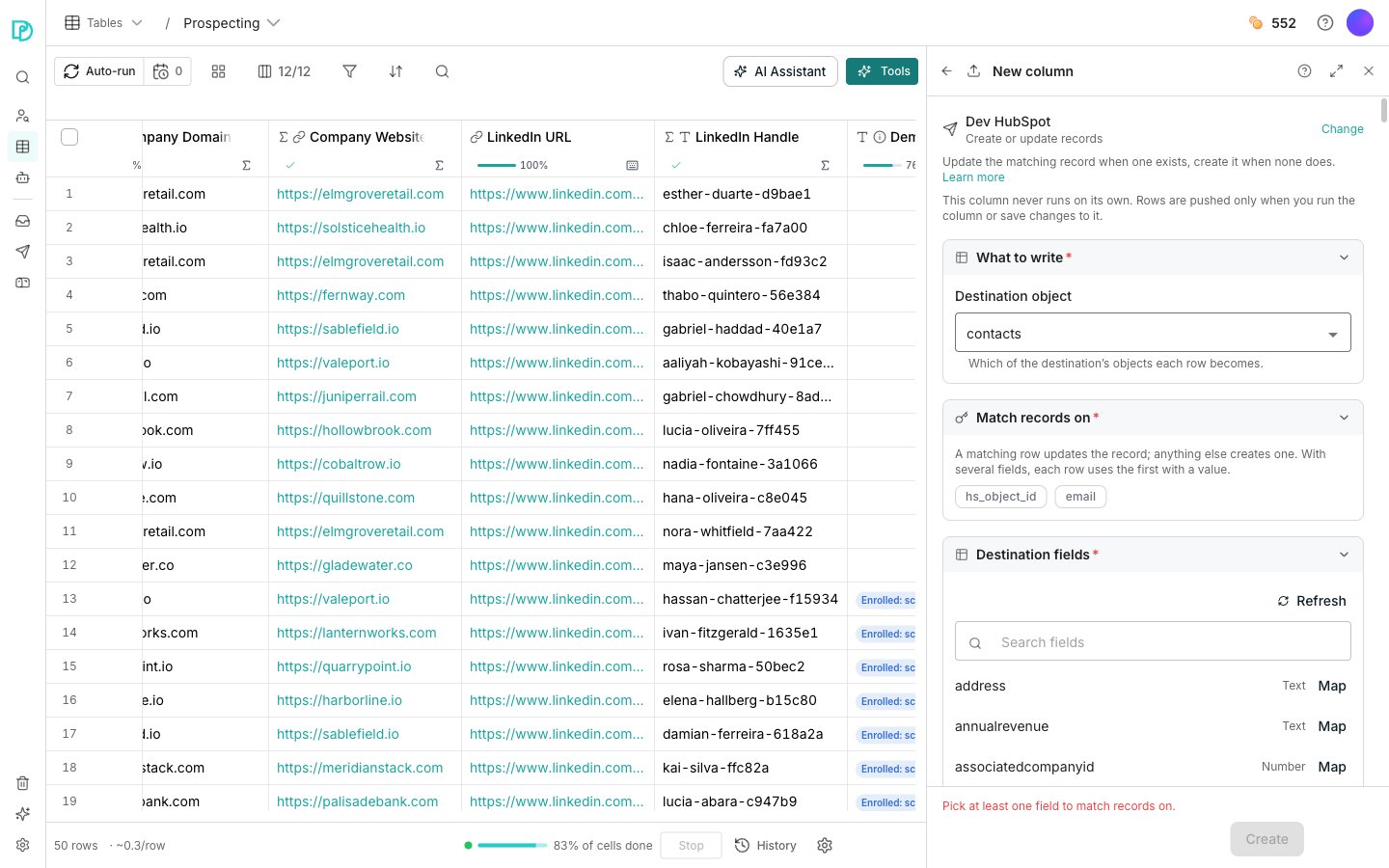
The export editor.
Set up an export
1
Pick the destination
Click Tools in the toolbar, then the Import & export tab. Click your connection under Connected systems and choose to export rows to it.
2
Choose what happens to records
Pick Create records, Update records or Create or update records. Each one is described below.
3
Choose the object
In What to write, pick the Destination object each row becomes. Oneprofile asks the connected tool what it holds.
4
Set the match fields
The card below it lists the fields the tool can match on. Pick one or more, and point each at the column holding that value.
5
Map what you want to write
In Destination fields, click Map beside a field. Type a value into it, or type
/ to insert a column.6
Test it, then create the column
In Preview, click Test on these rows. It asks the tool what a real run would do and writes nothing, so click Create once the answers look right.
Create records
Adds new records only. A row already written once is skipped, never duplicated. Its match card is Prevent duplicates by. Map at least one field there, so a row already at the destination can be recognised before anything is created.Update records
Changes existing records only. A row with no match at the destination is skipped. Its match card is Find the record by. Map at least one field there. No match means no write, so nothing new is ever created by this action.Create or update records
Updates the matching record when one exists, and creates it when none does. Its match card is Match records on. Map at least one field there. A row that matches updates its record, and a row that matches nothing creates one.Good to know
Matching on several fields is a fallback, not a combination
Matching on several fields is a fallback, not a combination
When you pick more than one match field, each row uses the first of them it has a value for. It is not a stricter match built from all of them together.
An export never runs on its own
An export never runs on its own
Run it from the column’s header menu. An export column offers Push all rows and Retry failed rows, and the retry never re-pushes rows that already went through.
Deciding what an update overwrites
Deciding what an update overwrites
When a record matches holds Write mode, which offers three settings.
- Change mapped fields only leaves the fields you have not mapped exactly as they are, and is the recommended setting
- Replace the whole record clears them
- Fill empty fields only leaves a field alone when it already has a value
Fields you cannot write to
Fields you cannot write to
A field the tool will not accept writes for is marked Read only and cannot be mapped. Refresh re-asks the tool for its field list. The browse button under Search fields carries the field count, and shows the ones you have not mapped yet.
Trying an export away from the real table
Trying an export away from the real table
Sandbox offers Create sandbox copy, which opens a copy of the table in a new tab. Nothing in the copy merges back, so it is safe to push from.
Sending rows in batches
Sending rows in batches
Batching offers Send rows in batches, which writes several rows per request instead of one at a time.
Retries, timeouts and rate limits
Retries, timeouts and rate limits
Reliability holds Retry failed rows with a Max retries count, a Timeout in seconds, and a Rate limit in requests per minute. The defaults suit most destinations, and the tool’s own answer is honoured whatever you set.
Nothing connected yet
Nothing connected yet
The destination picker says there are no connected destinations and offers Connect an integration, which opens the integrations page in a new tab. Your half-built column is still there when you come back.
Next steps
Connect integrations
Connect the tool you want to push rows into.
Run columns
Decide when a column runs, and over which rows.